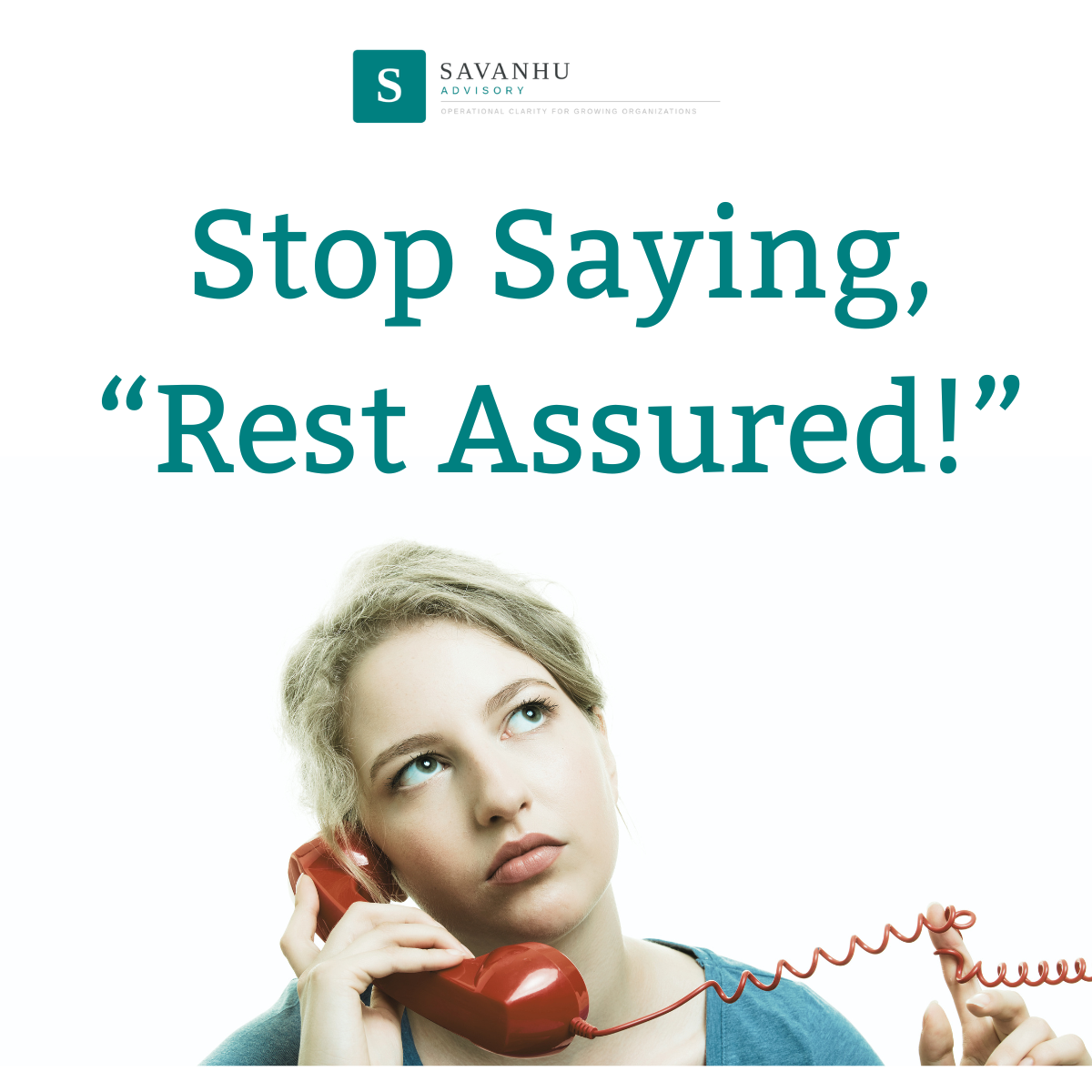
” And stop saying, ‘rest assured’ to me because this is the third time I have called you about this issue!”
That’s what I overheard my colleague saying to a customer service agent on the other end of the call. When she recounted the conversation, she said the agent stumbled on his words, after she told him to stop saying “rest assured”. Apparently, he didn’t know where to go next.
It was clear, he was trained to use the script, but he was not empowered to personalize his responses to the needs of the customer. While my colleague was feeling patronized by the use of the idiom, the agent was momentarily left speechless because his script didn’t tell him what to say when a customer says, “stop saying rest assured to me.”
The problem in particular with having “rest assured” as part of the customer service script, is that it has to be backed up with a solution for the problem. In my experience, every time a customer service agent has said to me, “Rest assured, Miss Savanhu, we will take care of the issue. ” I have inevitably had to call back about the same problem because “rest assured, ” it was not resolved.
The overuse of terms like “rest assured” may leave your customers shopping for another service provider rather than dealing with patronizing language from customer service agents who are clearly not listening to their needs nor resolving their problem. For the customer, repeated calls to solve the issue is a waste of their precious time.
So how do we fix this?
Customers want to feel like they are human. So while it’s a great practice to give agents a script they must be trained to use it as a guide rather than read it verbatim. They must be taught to listen to customers’ needs and respond accordingly. That’s the whole reason for speaking to a human customer service agent.
In The Worst CX Ever?, Scott Clark writes, “Customer service agents are often overly reliant on scripts, which can restrict their ability to empathetically and effectively engage with customers. In addition, these agents typically lack the authority to handle issues that deviate from standard procedures, leading to frustrating interactions for customers who require personalized solutions.”
It’s one thing to get a canned unempathetic response from an AI Agent, but it’s another to get it from a human customer agent. It’s frustrating, to say the least.
In a world where our capacity to be empathetic has been chipped away by our growing dependence on digital communication, it is even more important that we train our customer service agents on how to be empathetic in their interactions, genuinely responding to customer concerns rather than trying to rush them off with a repeated “rest assured.”
I’m sure this story sounds familiar to all of us because we have all likely been on the receiving end of this type of customer service, and perhaps your business is struggling with this very issue.
I’ve worked with organizations facing exactly this kind of challenge.
In my case study, From Dysfunction to Top Box: Customer Service Turnaround, I walk through how I helped a team move from broken, script-dependent customer service to a consistently high-performing one — by identifying where the real operational breakdowns were happening and building the systems and training to address them at the root.
Because here’s what I’ve learned: when a customer service team is struggling, the problem is rarely the people. It’s usually the structure — or the lack of one.
If your customers are calling back about the same issues, and your team is leaning on scripts because they don’t have the training or authority to do anything else, that’s an operational problem. And that’s exactly what I do.
I’m Brenda Savanhu, Customer Experience Strategist for service-driven small businesses . I’d love to help you retain your customers, by removing customer service obstacles.
Want to learn more? Book a free 30-minute Customer Service Consultation — no prep needed.